Dear listeners,
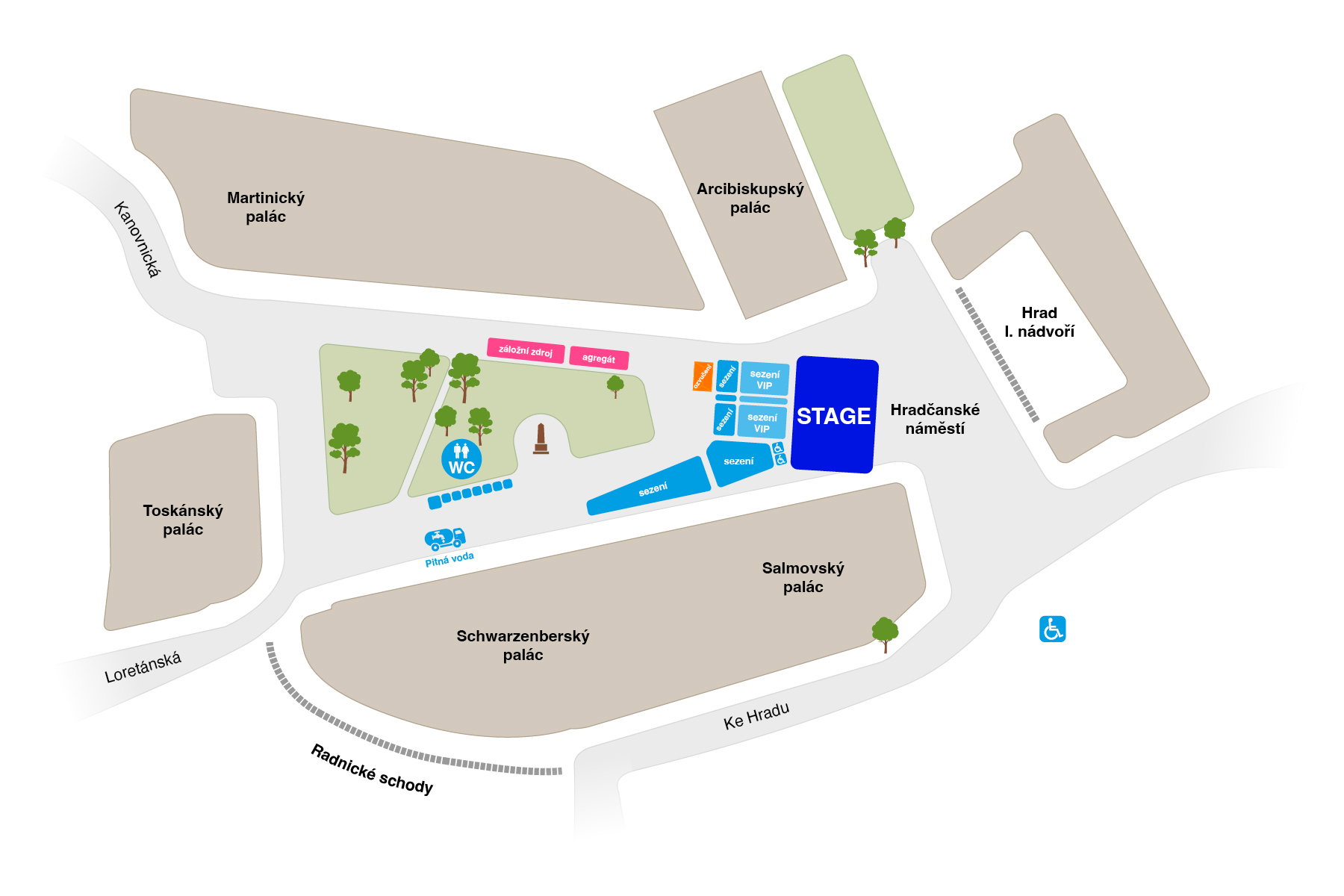
Join us in bringing the season to a close under the open sky. We will set up 700 seats on Hradčany Square, available on a first come, first served basis. There will, of course, be plenty of standing room as well. No tickets are required—access to the square is completely free.
The easiest way to reach Prague Castle by public transport is either via Malostranské náměstí (followed by a walk uphill along Nerudova Street or the Castle Steps) or via the upper route to the Brusnice and Pohořelec stops (please note that trams are currently not serving the Pražský hrad stop).
The weather forecast suggests high temperatures, so a drinking water tanker will be available for you (opposite Schwarzenberg Palace, next to the restrooms; see the map below). You are welcome to fill your bottle or simply refresh yourself. If you would like to be prepared for a sudden shower, please bring a raincoat—open umbrellas would obstruct the view of other audience members.
We are not planning any additional refreshments on site, but we promise you will leave nourished by beautiful music.
Wheelchair-accessible spaces will be available near the stage in the right-hand sector (see the map).
After the concert, the passage through Prague Castle will exceptionally remain open—the castle grounds will close at 11.00 p.m. instead of the usual time.
We look forward to seeing you there!
The media partner of the Open Air concert is Deník Metro.

![]()
Performers
Marek Kozák piano
The young Czech pianist Marek Kozák has been lauded for his impeccable technique, sense of proportion and gradation, plethora of registers, immense musicality and profound respect for the score. A highly cultivated performer, he enchants listeners with his ability to “convey with humility and without ostentatious gesture that which the composer aimed to express” (M. Bátor, Czech Radio, Vltava).
A graduate of the Academy of Performing Arts in Prague, where he studied under Ivan Klánský, he has received many international awards. In June 2021, he became a laureate of the prestigious Concours Géza Anda in Zürich. Moreover, he advanced to the final of the Ferruccio Busoni Competition in Bolzano and the semi-final of the Fryderyk Chopin Competition in Warsaw, and won the European Piano Competition in Bremen, where he also earned the audience prize. He received second prize at the 2016 Prague Spring Competition for his performance of Adam Skoumal’s The Juggler.
A pianist enjoying international renown, Marek Kozák has been invited to give recitals in Switzerland, Germany, Spain and other countries. Yet he has most frequently performed in the Czech Republic, appearing at such major events as the Leoš Janáček International Music Festival in Ostrava, Smetana’s Litomyšl, Dvořák Prague, Saint Wenceslas Music Festival and the Rudolf Firkušný International Piano Festival. He has performed with leading Czech orchestras as a soloist and within their recital cycles (in February 2023, he debuted as a guest of the Prague Symphony Orchestra at the Rudolfinum).
Besides the piano repertoire staples, primarily Fryderyk Chopin and J. S. Bach works (he performed both sets of The Well-Tempered Clavier at two successive editions of Smetana’s Litomyšl, for instance), he has also undertaken little-known piano concertos by Karel Kovařovic, Vítězslava Kaprálová and Pavel Bořkovec, which he has recorded with the Prague Radio Symphony Orchestra, conducted by Robert Jindra. His most recent album, Zapomenuté klavírní koncerty (Forgotten Piano Concertos), released in March 2024, has extended his discography, following his profile CD featuring pieces by Joseph Haydn, Fryderyk Chopin, César Franck, Sergei Rachmaninov and Adam Skoumal.
In addition to appearing as a soloist, Marek Kozák performs chamber music, most often along with the soprano Simona Šaturová and – as today – the cellist Václav Petr. Within the current Year of Czech Music, he and the German tenor Thoma Jaron-Wutz have prepared a recital focusing on Bedřich Smetana’s life. Mark Kozák also works as an educator, teaching at the City of Prague Music School.
Marek Eben host
Marek Eben is perhaps best known as a television presenter. He serves as the host of the popular StarDance competition and has been one of the key figures of the Karlovy Vary International Film Festival since 1996. A graduate of the Music and Drama Department at the Prague Conservatoire, Eben is also an accomplished musician.
The son of the late organist and composer Petr Eben, he continues his father’s artistic legacy in his own distinctive way as the sole songwriter for The Eben Brothers, a band that released its sixth album, Co my víme, at the start of the 2023/2024 academic year.
Eben’s work as a composer extends beyond his own ensemble. He has written music for the films Bizon and Hele on letí, as well as for the television series Poste restante. He has also composed music and lyrics for around twenty stage productions, including Othello at Studio Ypsilon and A Winter’s Tale at the National Theatre.
On Czech Television, in addition to StarDance, Eben has appeared in the quiz show The Treasure of Agnes of Bohemia, and his long-running talk show Na plovárně has become a beloved classic. He has twice been the overall winner of the TýTý Award, formerly presented to the most popular television personalities.
Alain Altinoglu conductor
Although the professional life of Alain Altinoglu today is not very different from that of his famed conducting colleagues, he took a truly unique path to the most prestigious concert halls and famed opera houses. He grew up in a poor suburb of Paris in a family with Armenian roots; his father was a professor of mathematics, and his mother was a pianist. He is said to have learned to read music before he knew the alphabet. He began playing the violin at age five, but he soon switched to piano, which he eventually studied, graduating from the Paris Conservatoire. However, it was the orchestral sound that the piano lacked that stayed with him: he listened to recordings of orchestral compositions and he gobbled up scores that had been collected by his grandfather. At age 20, he even had fun transcribing them for piano. This went hand-in-hand with his fascination with conducting: he enjoyed watching conductors and having discussions with them. He taught himself on his path to a conducting career, but he needed the opportunity to show what he could do.
That opportunity came by chance when at age 18 he was working as a repetiteur at Paris’s Opéra Bastille. At one of the rehearsals, it was necessary for him to stand in for the conductor Denis Russell Davies. The rehearsal went wonderfully, and the young repetiteur received great encouragement from the orchestra to pursue a conducting career. He still had a long way to go to join world’s elite conductors, and that is a part of his conducting philosophy: “To achieve the best result, you need maturity, and you need lots of time in your life. You have to be able to read between the lines. You are never finished; you have to work every day and try to understand why something did not go the way you wanted.” He sees the conductor as an intermediary between the orchestra and the listener, and he tries to convey the composer’s intentions to listeners while also presenting his own opinion.
At present he is employed as chief conductor of the Frankfurt Radio Orchestra and makes many guest appearances with orchestras including the Berlin Philharmonic, the Vienna Philharmonic, the Bavarian Radio Symphony Orchestra, the London Symphony Orchestra, and the Cleveland Orchestra. He shows his enthusiasm for opera as music director of the Théâtre Royal de la Monnaie, where his current projects include the entire Ring des Nibelungen. He is often seen at other opera houses from New York’s Metropolitan Opera to London’s Covent Garden. He teaches conducting at the Paris Conservatoire, and since July 2023 he has also been the artistic director of the International Festival in Colmar. He appears with his wife, mezzo-soprano Nora Gubitch, as a pianist in recitals, and they have made many recordings of the art song repertoire in which the husband-and-wife duo specialises.
His first live performance with the Czech Philharmonic came in 2022. At the rehearsals for a programme of music by Claude Debussy, Maurice Ravel, and Camille Saint-Saëns, he focused mainly on creating the authentic orchestral sound for the repertoire. As he put it: “I wanted to teach the orchestra to speak French.”
Compositions
Open air concert - programme of the evening
Born in the USA to Russian-Jewish parents, Alfred Newman (1900–1970) was a piano prodigy, but poverty forced him to earn money by playing in restaurants and theatres. He gained valuable experience in vaudeville, and by age 19 he was conducting on Broadway. His background suited him ideally to join with Max Steiner, Miklós Rózsa, Erich Wolfgang Korngold, and Dmitri Tiomkin as a pioneer of cinematic music. Besides composing film scores like The Robe (1953), All About Eve (1950), and How the West Was Won (1962), Newman continued to conduct in the studio, where he excelled at bringing his own or other composers’ music to the screen to the best possible effect.
In 1933, Newman composed a fanfare for 20th Century Pictures to accompany the company’s on-screen logo. The iconic miniature has come to symbolise Hollywood. In 1935, Century merged with Fox Film Corporation to form 20th Century-Fox, which continued to use the music now known as the 20th Century Fox Fanfare. Newman’s now familiar extended version dates from 1954.
Erich Wolfgang Korngold (1897–1957) was born in Brno to a German-speaking Jewish family. He began composing as a teenager, and by age 20, he had impressed Gustav Mahler, Alexander Zemlinsky, Richard Strauss, Artur Schnabel, and other important musical figures. His splendid opera Die tote Stadt remains in the repertoire. In the 1920s, his he took an interest in the operettas of Johann Strauss II, which he conducted and arranged. Korngold was already a world-famous composer when he began working in Hollywood in the 1930s, and his success there saved his life. When the Nazis seized power in Austria in 1938, California became his permanent home. Korngold’s works for the concert hall include a popular Violin Concerto, but his fame now rests on sumptuous scores for films like Captain Blood (1935) and The Adventures of Robin Hood (1938). The Sea Hawk (1940), a vehicle for Errol Flynn’s swordsmanship, shows Korngold at the height of his powers. Tonight, we will hear Korngold’s concert arrangement of the film’s Suite and Overture as reconstructed in 2003 by Patrick Russ, an American orchestrator and arranger.
Antonín Dvořák (1841–1904) wrote nine symphonies, though four early ones were only published posthumously, so the Symphony No. 9 was originally issued as his Fifth. Regardless of numbering, it is best known as the New World Symphony—a beloved work rich in memorable melodies, vivid colour, and dramatic flair. The second movement (Largo) is perfectly viable as a stand-alone piece, much like Smetana’s Moldau heard apart from the rest of Má vlast. Its many arrangements include the song Going Home with words and piano accompaniment by Dvořák’s American pupil William Arms Fischer. Ominous wind chords swell to a climax, then fade into hazy strings beneath a haunting cor anglais melody. This pentatonic theme, while suggestive of the African-American folk music Dvořák came to admire while working in the USA, is the composer’s entirely original creation. The middle section changes scenes with a funeral march followed by a poetic vision of nature and a moment of supreme exaltation. The music calms with the return of the cor anglais theme, interrupted by touching hesitations. At the end, the violins rise heavenward and disappear, leaving behind the radiant final chords in the double basses.
George Gershwin (1898–1937), a Brooklyn native of Ukrainian-Jewish heritage, studied composition under Rubin Goldmark, a colleague and pupil of Dvořák at New York’s National Conservatory. Gershwin first won fame writing songs for Broadway, then he branched out into music for the concert hall that incorporates the sound of vaudeville and jazz into a unique idiom all his own. Gershwin wrote his Piano concerto in F major (1925) for Walter Damrosch, the conductor of an orchestra that later merged with the New York Philharmonic. Damrosch wanted to capitalise on the success of Gershwin’s Rhapsody in Blue, and Gershwin was interested in another project crossing over into the classical music world. The striking result is one of the first modernist piano concertos. The first movement opens with a crash and bang, little fragments of themes, and the dance rhythm of the Charleston. A drum roll fades away, and the spotlight turns to the solo piano. Underlying the bluesy melody is a sharply dissonant accompaniment more reminiscent of early Schoenberg than jazz. The theme becomes the concerto’s motto and recurs throughout, sometimes cleverly disguised. Gershwin takes more than a half dozen themes, combining the rhythm of one with the melody of a second and the character of a third, resulting in almost endless permutations. Increasingly grand recurrences of the motto theme serve as formal guideposts.
The composer and conductor Leonard Bernstein (1918–1990) was the first American-born classical musician to achieve the unofficial status of a “superstar”. Brilliant and charismatic, the eclectic artist created and performed music of great artistic serious whether for Broadway, Hollywood, or the concert hall. His conducting communicated not only musical meaning to the orchestra players, but also raw emotion to enthralled audiences. In frequently televised children’s programmes or public lectures, he persuasively advocated for the art of music.
In 1949, Jerome Robbins came up with the idea of turning Shakespeare’s Romeo and Juliet into a musical in a modern setting, but the original plan, East Side Story, with Jewish and Catholic protagonists, proved a dead end. The idea breathed new life a few years later, this time featuring Puerto Rican and white youth gangs. The result, the musical-ballet-opera fusion West Side Story, with words by Stephen Sondheim and music by Leonard Bernstein, was a major hit on the stage and has been successfully adapted for the cinema twice (1961, 2021). Bernstein’s music echoes jazz, Latin, and modern classical styles, with more than a hint of the avant-garde’s daring, dangerous edge. In 1961, he shaped scenes from the show into a continuous stream of orchestral music titled Symphonic Dances from West Side Story with the collaboration of Sid Ramin and Irwin Kostal, who had assisted in orchestrating the original musical score as well.